Manual Entry starts after selecting Manual entry in the Input selection step and clicking Next. The wizard then continues with the remaining steps of the manual contract creation process.
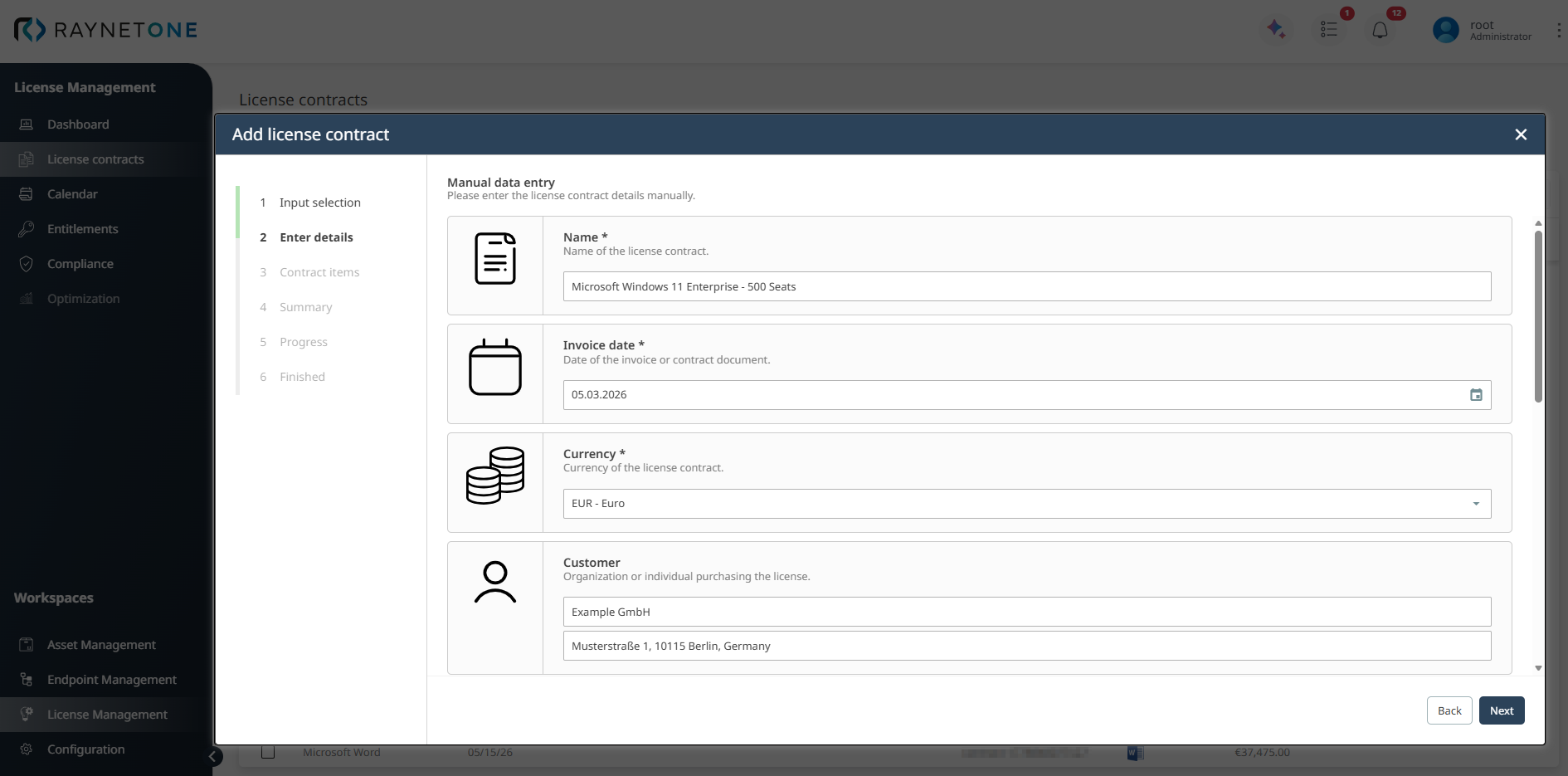
2. Enter details
Enter the core license contract information manually.
The following fields are displayed in this step:
•Name*: Name of the license contract.
•Invoice date*: Date of the invoice or contract document. This field is required and must be entered explicitly.
•Currency*: Currency of the license contract. The default value is based on the user's default currency configured in the profile settings.
•Customer: Organization or individual purchasing the license.
•Supplier: Organization or vendor providing the license.
•Contract ID: Unique identifier for this contract agreement.
•Invoice number: Billing document reference number.
•Purchase order (PO) number: Purchase order reference, if applicable.
•Enter order number: Sales order reference, if applicable.
•Quote number: Quote reference, if applicable.
After entering the contract details, click Next.
|
Be aware: |

 |
Best practice: |
3. Contract items
In the Contract items step, click + Add to create a new contract item. A contract item defines the purchased license rights and creates the corresponding entitlement.
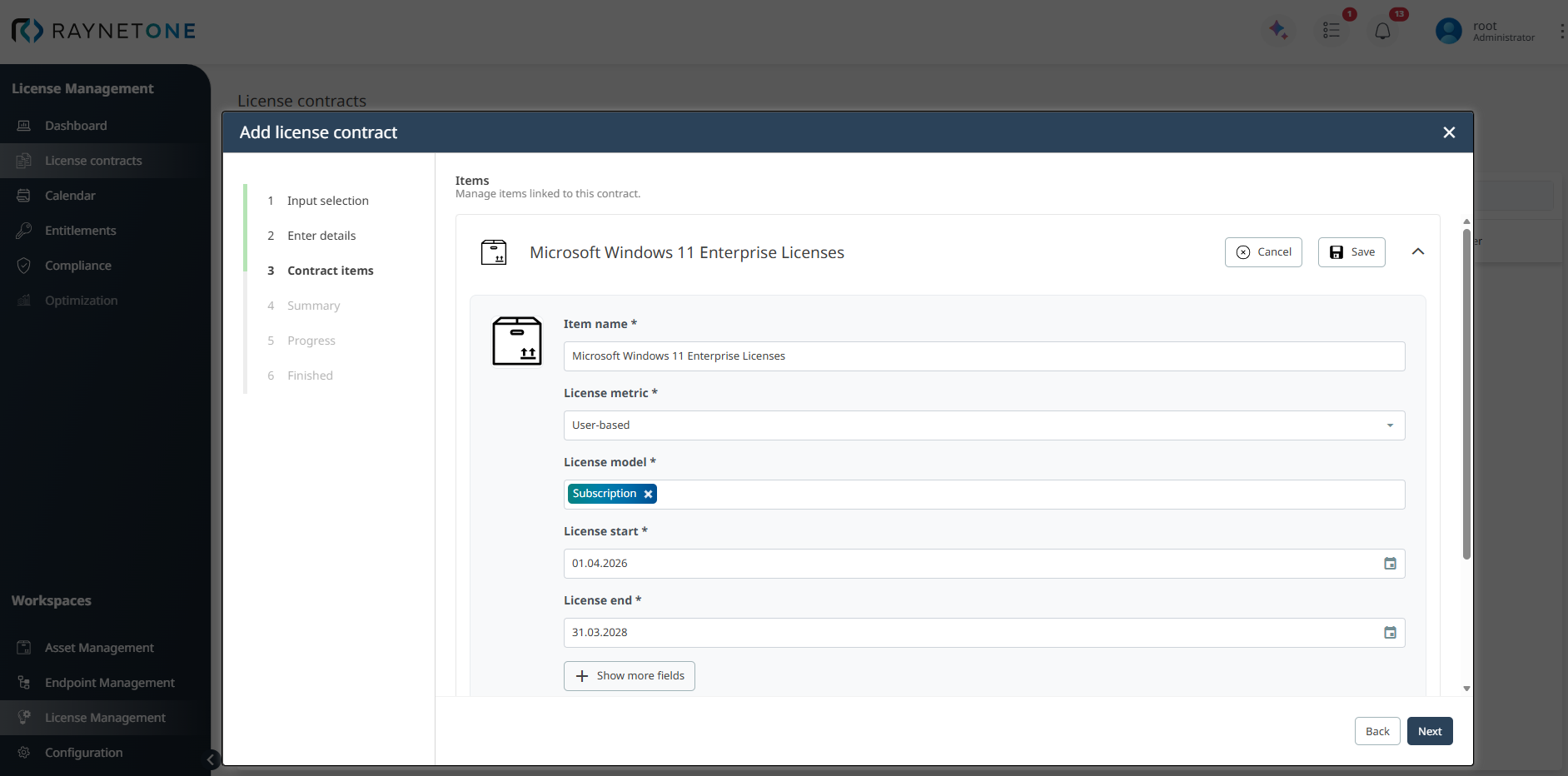
You can edit the following fields:
•Item name*: A descriptive name for the contract item.
•License metric*: Defines how licenses are counted and measured. This field directly impacts compliance calculations (e.g., Device-based, User-based, Core-based).
•License model*: The commercial model of the license (e.g., Perpetual, Subscription, Maintenance). This field determines which type of entitlement is created.
•License start*: Start date of the license entitlement. This date triggers the automatic generation of a Purchased Event in the Raynet One Calendar.
•License end *: End date of the license entitlement or subscription. If left empty, the license is treated as perpetual with no expiration. If filled,Raynet One generates a License Expiration Warning on the final day of validity.
Click + Show more fields to display additional contract item details.
The following additional fields are available:
•SKU: The manufacturer's stock keeping unit or product identifier Example: KW9-00657.
•Product number: Additional internal or vendor-specific product number.
•License pack*: The packaging or bundle size of the license.
•Quantity*: Number of licenses or entitlements purchased.
•Currency: Currency of the contract.
•Unit price*: Price per license or per item.
•Billing interval: Defines the billing interval for subscription-based licenses, such as monthly or yearly.
•Billing period: Defines the billing period for subscription-based licenses.
•Total cost: Automatically calculated based on Unit price and Quantity.
After entering all required contract item data, click Save to add the item and its entitlement to the contract. Click the + Add button to add additional contract items if the contract covers multiple products or configurations.
|
Be aware: |
|
Best practice: |
After adding all required products, click Next to proceed to the Summary step.
4. Summary
In the Summary step, Raynet One displays a complete overview of all entered information before the contract is finalized.
You will see two main sections:
•License contract details: All data from the Enter Details step (contract name, IDs, customer supplier, invoice date, total costs, etc.).
•Items: A summary of all products and entitlements linked to this contract, including quantity, license model, metric, and calculated total cost.
Review all information before submission.
•If anything is incorrect, click Back to return to the previous steps and make changes.
•If anything is correct, click Create to finalize the contract creation.
5. Progress
After clicking Create, Raynet One processes the contract, validates the data, links the entitlements, and performs initial analysis with SAM AI. This step usually completes within a few seconds.
6. Finished
Once processing is complete, the new contract and its entitlement are now fully available in the License Contracts list and can be used for reconciliation, compliance tracking, and optimization. Click
Finish to close the wizard.
Automatically generated Calendar events
Raynet One One automatically generates related Calendar events based on the data you entered:
TRIGGER |
GENERATED EVENT |
DESCRIPTION |
|---|---|---|
•Invoice date (first purchase) |
•New Purchase Event |
•Marks the initial contract purchase |
•Invoice date (renewal) |
•Contract Invoiced Event |
•Marks a contract renewal or follow-up invoice |
•License start date (first purchase) |
•Purchased Event |
•Confirms entitlement activation |
•License start date (renewal, same entitlement) |
•Purchased Renewal Event |
•Marks a renewal on an existing entitlement |
•License end date |
•License Expiration Warning |
•Displayed on the final day of license validity |
|
Be aware: |
•The Invoice date triggers a New Purchase or Contract Invoiced event.
•The License start date creates a Purchased Event.
•The License end date generates a License Expiration Warning (shown on the final day).
|
Best practice: |